

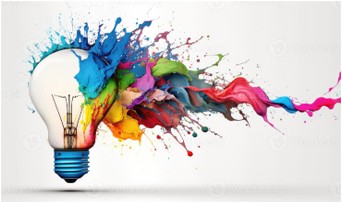
As we may be aware, in biology, metamorphosis is not a metaphor, it is a survival mechanism. An organism changes form not because it seeks novelty, but because its existing structure can no longer thrive in a transformed environment. The process is systemic: neural pathways reorganize, energy systems recalibrate, and cognitive priorities shift to meet new demands.
I observe that the creative industry is undergoing a similar transformation.
What we are witnessing today is not simply the adoption of artificial intelligence as a productivity enhancer. It is a cognitive and scientific reconfiguration of how creativity itself is produced, evaluated, and scaled. This is not an artistic debate. It is a neurological, computational, and behavioral shift.I see this evolution from two angles: the science of how creativity actually functions, and the commercial reality of what will no longer be competitive going forward.
The question, therefore, is not whether AI is good or bad for creativity. That framing is already outdated. The more relevant question is:
Why is learning AI becoming scientifically inevitable for creative leaders who want to stay structurally ahead? I pen my thoughts in the following points.
Creativity Through the Lens of Cognitive Science
For decades, creativity was treated as an intuitive or even mystical capability driven by talent, instinct, and inspiration. Cognitive neuroscience has steadily dismantled that view. Creativity, as science now understands it, is not a singular act. It is a distributed cognitive process involving pattern recognition, memory recombination, probabilistic prediction, emotional valuation, and contextual judgment. The brain creates by identifying patterns, disrupting them, and recombining them into novel configurations—while continuously assessing relevance and emotional impact.
This is where AI becomes deeply consequential.
Modern AI systems excel at large-scale pattern detection and recombination. They do not ‘imagine’ in the human sense, but they replicate a significant portion of the brain’s combinatorial mechanics at speeds and scales no individual mind can match.
The implication is profound: creativity is no longer constrained by ideation bandwidth. It is constrained by interpretive intelligence.
From Creative Scarcity to Cognitive Abundance
One of the most disruptive scientific realities introduced by AI is the collapse of creative scarcity.
Historically, creative advantage was rooted in having more ideas, faster ideas, or more original ideas. AI neutralizes that advantage almost instantly. It can generate thousands of variations, scripts, visuals, and narrative structures in minutes.
This does not devalue creativity. It redefines where its value resides.
Cognitive science tells us that when abundance increases, selection becomes the critical differentiator. Selection requires higher-order brain functions: prefrontal reasoning, ethical evaluation, emotional regulation, and long-term consequence modeling.
From a CEO’s perspective, this is the new creative economy. The most valuable leaders are no longer those who generate ideas relentlessly, but those who curate meaning intelligently.
AI raises the creative floor. Humans must raise the cognitive ceiling.
Pattern Fluency: The New Scientific Advantage
In my work as an executive coach, I often speak about pattern fluency—a concept grounded in neuroscience and systems thinking. Pattern fluency is the ability to detect weak signals before they crystallize into obvious trends.
AI dramatically enhances this capability.
By analyzing shifts in language, imagery, sentiment, and consumer behavior across markets and cultures, AI surfaces micro-patterns that human intuition alone would struggle to perceive. This does not replace instinct it augments perception.
From a biological standpoint, this mirrors human evolution itself: expanding sensory input to improve adaptation and survival. In creative leadership, expanded perception improves relevance.
Leaders who develop AI fluency gain a structural advantage:
- They sense cultural fatigue earlier
- They test narrative hypotheses before scaling them
- They reduce cognitive bias by exposing themselves to counter-patterns
Creativity does not become mechanical. It becomes more informed, not less human.
AI as Cognitive Prosthesis, Not Creative Replacement
One of the industry’s most persistent misconceptions is that AI replaces creative thinking. Neuroscience suggests the opposite.
AI functions as a cognitive prosthesis an extension of mental capacity. Just as calculators did not eliminate mathematical thinking but freed humans to focus on higher-order problem solving, AI reduces lower-order cognitive load. When that load is reduced, higher-order reasoning improves.
In creative terms, this means less energy spent on repetitive ideation and more attention devoted to narrative coherence, emotional authenticity, ethical nuance, and long-term brand meaning.
From a CEO’s standpoint, this is precisely why AI learning is becoming unavoidable. Organizations that refuse cognitive augmentation will burn human talent on tasks machines already perform more efficiently.
Identity, Neuroplasticity, and Creative Leadership
The most underestimated challenge in AI adoption is not technological. it is neurological. Neuroplasticity tells us that the brain reorganizes itself based on repeated behavior. Creative professionals who resist AI are not preserving creativity; they are reinforcing cognitive habits that may soon become maladaptive.
In coaching conversations, resistance often appears philosophical or ethical. But beneath it lies something more human: fear of identity erosion. Many creatives built their sense of value around speed, originality, or craft mastery. AI disrupts those markers. That discomfort is real but scientifically, it is also a signal of transition. Growth requires discomfort. Neural adaptation occurs when existing patterns are challenged.
So, what this indicates is rebuilding identity around synthesis, judgment, and meaning, not output alone.
Creativity as an Intelligent System
From the boardroom, one truth is becoming unavoidable: creativity is no longer an isolated function. It is an intelligent system integrating data, technology, human insight, and cultural intelligence. Clients are no longer buying ideas in isolation. They are buying foresight, speed with responsibility, personalization with integrity, and creativity that adapts in real time.
AI literacy has therefore become strategic literacy. I do not need every creative to become a technologist. But I do need leaders who understand how AI reshapes cognition, decision-making, and competitive advantage because strategy today is inseparable from science.
In a nutshell, AI will not end creativity. But it will end outdated definitions of creative value. The next metamorphosis of the creative industry is not artistic.
It is cognitive.
____________________________________________________________________________________________
The views and opinions published here belong to the author and do not necessarily reflect the views and opinions of the publisher.

