

We are living through a subtle but profound shift in how stories are imagined, created and felt. Artificial intelligence is no longer hovering at the edges of creativity as a novelty or efficiency tool. It has entered the creative process itself—quietly, steadily and irreversibly. This moment calls for a new way of understanding storytelling, one that goes beyond tools and techniques. It invites us to think in terms of trans-intelligence storytelling: a human-led mode of creation where distinct intelligences converge without fusion, each bounded ethically and creatively, allowing meaning to emerge at the intersection rather than being generated by any single intelligence.
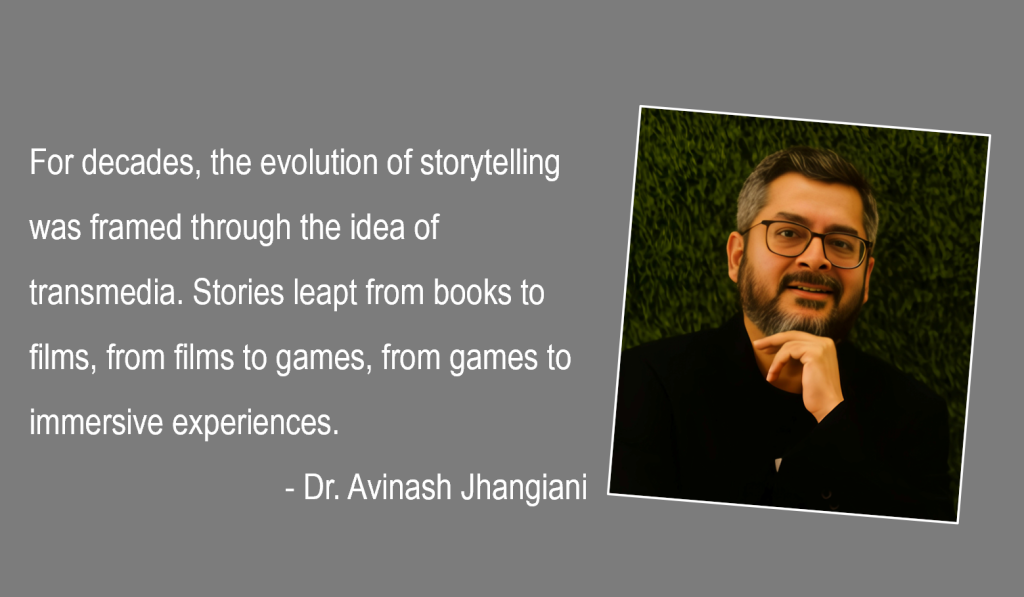
For decades, the evolution of storytelling was framed through the idea of transmedia. Stories leapt from books to films, from films to games, from games to immersive experiences. The transformation was largely about where a story lived. What is different today is that the transformation is about who and what participates in the act of creation itself. Intelligence, not just medium, has become plural.
At the center of trans-intelligence storytelling lies a crucial distinction. This is not about AI replacing human creativity, nor about machines learning to “feel” like us. It is about orchestration. Human intention, emotion and moral judgment remain the primary source of meaning, while artificial intelligence expands the scale, complexity and expressive range of what can be realized. The hierarchy matters. When this order is preserved, stories gain depth. When it is inverted, they feel hollow.
One of the most compelling real-world examples of this balance can be seen in Spider-Man: Across the Spider-Verse. While often celebrated for its visual innovation, the film’s deeper achievement lies in how it embodies trans-intelligence storytelling without ever naming it. The heart of the story—identity, belonging, choice and sacrifice—is unmistakably human. These themes are not discovered by algorithms; they are authored through lived experience, cultural memory and emotional risk. Yet the film’s extraordinary visual language, its fluid transitions across worlds and its ability to sustain stylistic diversity at scale would be nearly impossible without advanced computational intelligence supporting the process.
What makes the Spider-Verse films resonate is not technical perfection but intentional imperfection. Lines jitter. Styles clash. Frames resist polish. These are not flaws to be corrected by machines but human decisions to preserve emotional texture. The filmmakers use technology not to smooth meaning, but to stretch it. AI-assisted tools amplify the canvas while the human hand deliberately leaves visible brushstrokes. This tension—between precision and irregularity—is where authenticity lives.
A similar tension can be seen closer home in two contemporary retellings of the Mahabharata. JioStar’s Mahabharat: Ek Dharmayudh foregrounds technological scale, openly positioning itself as an AI-powered production experiment, while Netflix’s Kurukshetra takes a quieter route, reframing the epic through a limited set of moral perspectives rather than computational spectacle. What distinguishes the two is not ambition or intent, but hierarchy. In the former, attention often shifts toward the method—how the story was produced—whereas in the latter, the lens through which the war is experienced remains unmistakably authorial. Both are attempts to modernize an ancient epic, yet they reveal an important lesson: trans-intelligence does not emerge from the presence of advanced tools alone. It emerges when technology remains visibly in service of meaning, when authorship is legible and when the story’s ethical weight is allowed to arise at the intersection of human choice and technical possibility, rather than being overwhelmed by either.
This is where many contemporary experiments with AI-generated content falter. When artificial intelligence is asked to lead meaning rather than serve it, audiences sense the absence of authorship. The discomfort people feel toward certain AI-generated stories is not a rejection of technology itself, but a reaction to missing intention. We are deeply attuned to whether a story has been stood behind by a human being. Trans-intelligence storytelling makes that authorship legible rather than obscured.
Younger generations intuitively understand this distinction. For them, AI is not an intrusion into creativity but part of the environment in which creativity unfolds. They do not experience co-creation with machines as a loss of authenticity, because authenticity was never about isolation to begin with. It was always about choice, responsibility and meaning. What matters is not whether a tool is human or artificial, but who decides why something is created and what it stands for.
This reframing allows us to move beyond the tired debate of “human versus machine.” Trans-intelligence storytelling is neither surrender nor resistance. It is convergence with boundaries. Human intelligence brings values, ambiguity, empathy and moral weight. Artificial intelligence brings pattern recognition, speed, variation and scale. Emotional and cultural intelligence ensure that stories remain grounded in lived reality rather than abstract optimization. When these intelligences interact—without dissolving into a single voice—something genuinely new emerges.
The power of such storytelling does not reside in any single layer. It emerges at the intersection. In the Spider-Verse, meaning does not sit solely in the script, nor in the animation, nor in the technology stack. It arises where human intention meets machine capability, where cultural storytelling traditions meet computational possibility. This is why the experience feels expansive rather than synthetic.
At its core, trans-intelligence storytelling is a response to a deeper cultural anxiety: the fear that as machines grow more capable, humanity will grow less visible. The truth may be the opposite. When used with clarity and restraint, AI does not erase humanity—it reveals it more sharply. It forces us to articulate what only we can bring: purpose, conscience and the courage to choose imperfection over optimization.
The future of storytelling, then, is not about making AI more human. It is about making humanity more possible at scale. In embracing trans-intelligence storytelling, we are not abandoning authorship; we are redefining stewardship. We remain the ones who decide what stories matter, why they exist and what they ask of those who encounter them. AI simply helps those stories travel further, stretch wider and reach deeper—without losing their soul.
____________________________________________________________________________________________________________
The views and opinions published here belong to the author and do not necessarily reflect the views and opinions of the publisher.

