

The concept of “being found” has evolved significantly over the years. The shift from Yellow Pages to AI powered search engines represents a journey from physical, high friction directory browsing to automated, hyper-local and conversational intelligence.
Professionally, being discovered meant simply being found. You searched for something, a list appeared and you clicked on what seemed relevant, forming your own opinion.
However, this model has changed.
Today, we’re not just searching for answers; we’re analysing them. AI helps us compare, recommend, explain and often make decisions faster, more timely and accurately. This raises a pertinent question for brands: what happens when you’re no longer competing to appear in search results but to be part of the answer?
From Visibility to Credibility
Search was fundamentally a visibility game. Brands competed for rankings, clicks and attention. AI led discovery introduces something different. The system is not simply showing people where to look. It is interpreting information, deciding what to surface and what to recommend. That changes what being discoverable actually means.
Think about how decisions get made today. A prospective customer asks an AI tool: Which companies are leaders in this category? Which one has the strongest reputation? What are the risks? The brand’s website might be part of that information ecosystem. But so might a news article, an analyst report, an expert’s commentary, a podcast, a LinkedIn post or a review. The AI is synthesising all of it.
This means a brand can be represented in a conversation without ever controlling that narrative. That is fundamentally a communications challenge, not a search optimisation challenge.
Building the Evidence
For years, we have been comfortable with the idea that brands control their own channels. AI makes that ecosystem more fluid. It can pull together fragments from different places and turn them into a single narrative about who you are.
This is where earned media becomes critical again. A credible third-party source talking about your organisation is no longer valuable only because someone might read it. It becomes one of the signals through which an AI system understands who you are. The same is true of expert commentary, original research and customer experiences. Your reputation now has a machine audience.
What This Means for Brands
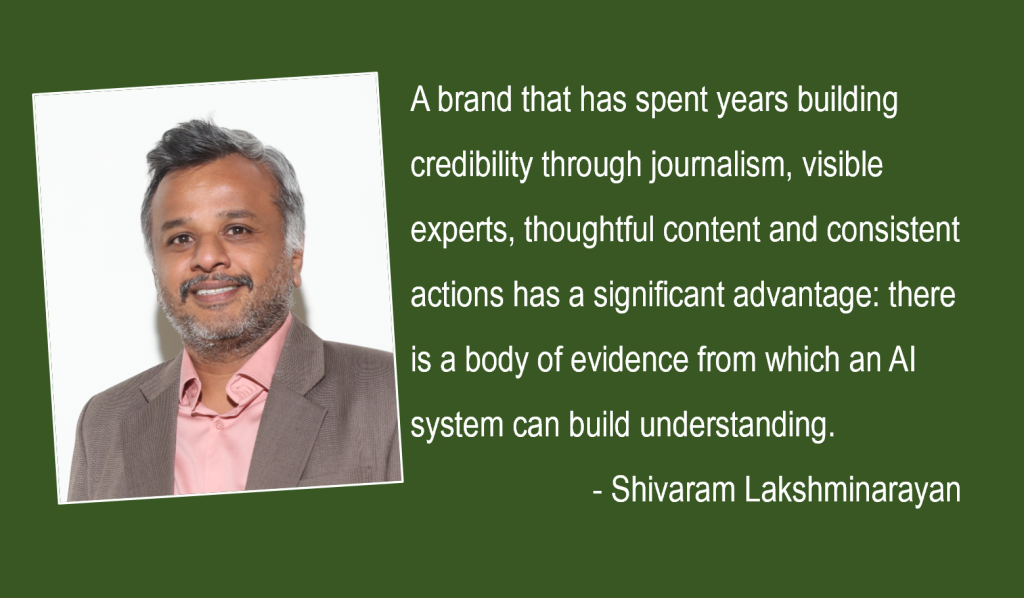
AI systems do not experience a brand the way a consumer does. They process signals, connect information, identify patterns and synthesise what they find. A brand that has spent years building credibility through journalism, visible experts, thoughtful content and consistent actions has a significant advantage: there is a body of evidence from which an AI system can build understanding.
That is very different from trying to create visibility overnight because a new technology has made it important. This requires communications to move upstream. If brands want to influence how they are understood in an AI-driven discovery layer, they cannot start thinking about it when a campaign goes live. They need to build a reputation long before someone asks an AI tool about them.
Four Questions Every Brand Should Ask
This translates into a practical framework:
- Are we contributing something useful to our category?
- Are our leaders part of the conversations that matter?
- Are credible people talking about us for the right reasons?
- Does what people say about us match what we say about ourselves?
That last question matters most. AI has made the gap between internal narrative and external perception much harder to hide.
The Real Opportunity
I do not think traditional search is disappearing. But the behaviour around it is changing. People are moving from finding information to interrogating it. That changes what visibility means. For brands, the objective cannot simply be to occupy more digital real estate. It has to be to build enough credibility, relevance and consistency that when the question is asked to an AI or a person, there is something worth saying about you. That is not about teaching machines to like your brand. It is about building a brand credible enough to be found, relevant enough to be discussed and trusted enough to be recommended.
For communications, that is a much bigger job than search optimization. And perhaps a much more interesting one.
________________________________________________________________________________________________________________________
The views and opinions published here belong to the author and do not necessarily reflect the views and opinions of the publisher.

