

I observe this as a lesser talked about subject and hence this week I choose to write around this. Let me start by saying, in the corridors of corporate power, competence gets you a seat at the table but gravitas determines whether anyone listens when you speak. It’s that quiet force that anchors a leader amid volatility — the signal of credibility that can steady an entire board during a crisis. I would want to also mention here that the ‘practices’ mentioned in this article is not a prescription and must be observed with the guidance of a professional coach (like me).
Yet gravitas seems one of the most misunderstood qualities in leadership. It isn’t about volume or dominance; it’s about resonance, the invisible gravity that pulls attention without demanding it.
Drawing from behavioral science, neuroscience, and few years of leadership coaching at C-suite, I am sharing 5 scientific dimensions of gravitas and how senior leaders & board members may consciously practice and cultivate each.
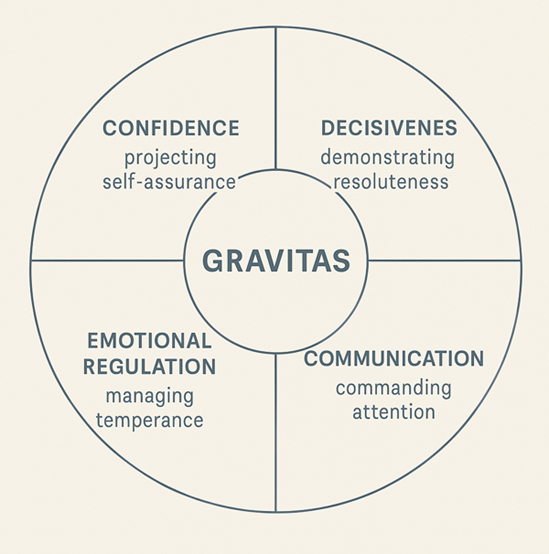
This image is AI generated by the author, for quick reference for the readers
- Emotional Regulation: The Neurobiology of Composure
What research says:
A study (interesting one too) linked composure under stress to enhanced activation in the prefrontal cortex, the part of the brain that regulates decision-making and emotional control. In boardrooms, where high-stakes issues demand calm under ambiguity, this neural steadiness becomes visible as gravitas.
A way to practice:
Before a crucial discussion, use a 90-second “neural reset”: exhale slowly, label your emotion (“I feel tense”), and refocus on the meeting’s objective. This engages the prefrontal cortex and calms the limbic system.
After the meeting, reflect: What emotion led my tone? What tone shaped others’ reactions? Over time, this reflection rewires your stress-response loop — composure becomes your credibility.
- Strategic Silence: Influence Through Cognitive Space
What research says:
A research (this is behind a paywall) found that leaders who pause strategically during conversations increase listener retention by up to 20%. Silence, when intentional, creates cognitive space — signaling thoughtfulness and confidence rather than hesitation.
A way to practice:
In your next board discussion, hold a 3-second silence after a complex statement or question. Let the silence work for you — it invites reflection and signals authority.
Observe the shift: others begin leaning forward, waiting for your next word. That’s the psychology of presence — gravitas amplified through restraint, not dominance.
- Intellectual Breadth: Does Gravitas Grows Where Curiosity Lives?
Certain highlight that leaders rated high on gravitas often combine deep expertise in one area with active curiosity in adjacent fields, a pattern known as “T-shaped mastery.” This cross-domain curiosity enhances credibility because it widens interpretive context.T-Shaped leadership is also followed in some of the organizations globally.
A way to practice:
Maybe once a quarter, engage in cross-domain immersion. If you’re a finance board member, explore behavioural economics; if you’re in tech, read about cognitive bias in decision-making. Then, during discussions, integrate that broader lens: “Here’s a behavioural variable we might be missing…”Gravitas grows not from titles, but from “pattern recognition” the ability to see beyond your silo and articulate the unseen connections.
- Contextual Calibration: Gravitas Is Culturally Intelligent
What the research says:
In this paper by The Truist Leadership Institute indicates that that executive presence is culturally moderated. This paper mentions “Examples include the 7 C’s (composure, connection, charisma, confidence, credibility, clarity, conciseness); a 3-component model (effective communication skills, self-awareness, and appearance); and yet another model claiming that executive presence depends on the ability to inspire others, assertiveness in role, and consistent “demonstration of confidence. What signifies gravitas in one geography (measured pace and minimal expression in Japan) may be misread as aloofness in another (say, the U.S., where energy conveys engagement). Gravitas, therefore, isn’t static — it’s context-responsive.
A way to practice:
Before every cross-cultural board session, do a presence audit: understand the group’s communication rhythm, emotional expressiveness, and tolerance for ambiguity. Then adapt consciously — modulate tone, posture, and pacing. Ask a trusted peer post-meeting: “How did my presence land in this room?”
That feedback loop cultivates what neuroscientists call social attunement, the neural mirroring that deepens connection and strengthens your perceived credibility.
- Deliberate Practice: Gravitas Is a Trainable Skill, Not a Trait
More often I recommend Daniel Goleman’s work on emotional competence which shows that presence and influence develop through repeated, feedback-rich micro-practices that strengthen neural circuits related to attention, empathy, and vocal modulation. Gravitas, in essence, is neuroplastic — it can be built.
A way to build your practice:
Design a 12-week gravitas regimen:
- Record your short board updates; analyze tone, pacing, and clarity.
- Rehearse high-stakes questions with a trusted peer.
- Solicit one piece of feedback after each major meeting (“What stayed with you after I spoke?”).
Track progress in a simple log. Within months, you must notice fewer fillers, steadier tone, and a calmer command of silence — the external markers of internal mastery. However, as I always say, get a professional coach if you really want to get this practice from deep within. Being an ICF accredited PCC, I help leaders to become their next best version which also includes building on gravitas for some of my coaches.
Gravitas as Ethical Resonance
In a world of volatility and visibility, gravitas isn’t an aesthetic accessory — it’s a strategic stabiliser. At its core, gravitas is not about appearing powerful; it’s about projecting psychological safety — making others feel anchored in your clarity. Ultimately, gravitas is ethical resonance in motion — the calm authority that earns trust not by assertion, but by authenticity. And that, in today’s boardrooms, may just be the most sophisticated form of influence there is.
The views and opinions published here belong to the author and do not necessarily reflect the views and opinions of the publisher.

