

The modern workplace no longer rewards static excellence. It rewards recalibration. Strategies pivot mid-quarter. Artificial intelligence rewrites job roles faster than job descriptions can keep up. Entire industries move from dominance to disruption in a few years. In such an environment, intelligence cannot be defined merely by analytical strength or domain expertise. The defining meta-skill of this era is adaptive intelligence—the capacity to continuously evolve, thrive under uncertainty, and pivot in the face of change. Within learning and development ecosystems, this capacity is fast becoming the difference between relevance and redundancy.
Adaptive intelligence, measured by AdaptQ, in the workplace is not about reacting impulsively to every new trend. It is about integrating 5 key quotients—RQ (Resilience), EQ (Emotional Intelligence), LQ (Learning Agility), IQ (Cognitive Intelligence), CQ (Curiosity)—into a coherent response.
Consider Satya Nadella. When he took over Microsoft, the company was perceived as powerful yet culturally rigid. Rather than doubling down on legacy dominance, he shifted the internal narrative from “know-it-all” to “learn-it-all.” By foregrounding empathy and curiosity, he transformed not only product strategy but organizational mindset. This was not a technical pivot alone; it was an adaptive one. Contrast this with leaders who struggle to update their mental models when markets change. High cognitive ability without emotional and cultural recalibration often results in strategic stagnation.
Similarly, Sundar Pichai demonstrates a form of quiet adaptive leadership. In navigating regulatory scrutiny, AI ethics debates, and internal cultural tensions, his approach has leaned toward composure and systems thinking rather than reactive escalation. Adaptive intelligence here is visible in restraint—balancing innovation with responsibility. On the other end of the spectrum, Elon Musk exemplifies extraordinary cognitive boldness and risk appetite. His ability to reinvent industries reflects strong strategic adaptability. Yet public criticisms around emotional volatility highlight how uneven integration across dimensions can impact team trust. Adaptive intelligence is rarely about brilliance in one dimension; it is about balance across several.
The contrast becomes sharper in high-growth and high-pressure environments. Indra Nooyi steered PepsiCo through strategic reinvention by integrating long-term health trends with operational performance. Her emphasis on “performance with purpose” reflected an ability to anticipate cultural shifts rather than react defensively. Meanwhile, in India’s edtech surge, Byju Raveendran built rapid scale during a digital boom. However, the subsequent turbulence illustrates how hyper-growth without sufficient adaptive recalibration—particularly in governance and sustainability—can strain even visionary ventures. Rapid expansion demands not just ambition but reflective course correction.
The AI revolution offers further illustrations. Sam Altman operates at the frontier of technological acceleration. Navigating internal board conflicts, public scrutiny, and global AI policy debates requires not only strategic foresight but emotional and political agility. The ability to recover and reposition amid public turbulence signals resilience under pressure. In India’s enterprise technology landscape, Sridhar Vembu provides a contrasting model. By building globally competitive products from non-metropolitan ecosystems, he challenges conventional growth narratives. His decentralized, long-horizon approach reflects adaptability rooted in cultural awareness and structural innovation rather than speed alone.
Financial markets also test adaptive capacity. When AI analytics firm Fractal prepared for public listing adjustments, leadership faced investor recalibration and valuation pressures. Srikanth Velamakanni has spoken about the importance of long-term conviction amid short-term volatility. Adaptive intelligence in such contexts is not about immediate validation but about sustaining strategic clarity when external signals fluctuate.
These examples reveal a pattern. Adaptive intelligence is not the absence of error or criticism. It is the ability to absorb complexity without fragmentation. Leaders who exhibit high adaptability demonstrate learning agility, emotional composure, and strategic recalibration. Those who struggle often possess significant expertise yet resist updating assumptions or integrating feedback. In volatile environments, rigidity magnifies risk.
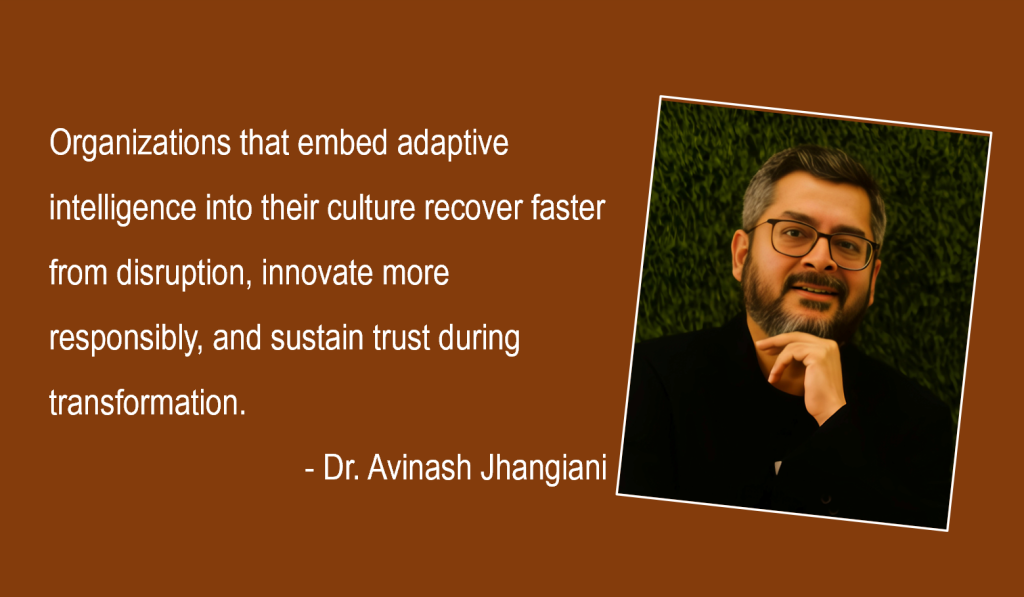
For learning and development professionals, this insight carries profound implications. Traditional corporate training models focused on skills acquisition—coding proficiency, financial acumen, presentation mastery. Today, the greater need lies in cultivating meta-capacities: reflective thinking, emotional regulation, cross-functional empathy, and resilience under uncertainty. Employees must not only learn new tools but learn how to continuously unlearn and relearn. Organizations that embed adaptive intelligence into their culture recover faster from disruption, innovate more responsibly, and sustain trust during transformation.
In the recent Wall Street Journal article, “What AI Executives Tell Their Own Kids About the Jobs of the Future,” leaders from companies like Anthropic, Microsoft, SAP, Paid.ai, and Wharton aren’t teaching their kids to out-code the machines, instead adaptability, critical thinking and being more human are being reinforced. As AI systems assume greater analytical responsibilities, the uniquely human edge shifts upward—to judgment, ethical discernment, contextual integration, and emotional nuance. These capacities are not static traits; they are cultivated disciplines. Adaptive intelligence ensures that as technology accelerates, leadership remains grounded. In a workplace that refuses to sit still, the ability to evolve coherently may be the most valuable form of intelligence of all.
_________________________________________________________________________________________________
The views and opinions published here belong to the author and do not necessarily reflect the views and opinions of the publisher.

