

For years, we pondered whether artificial intelligence could ever truly be conscious. We witnessed AIs mastering chess, composing poetry, diagnosing illness, even mimicking empathy. Still, something always lacked substance—like a mind without a body. Perhaps that was exactly what it was. And now, that may be changing.
AI has long lived in abstraction—confined to data sets, models, servers, generating analyses and responses without ever touching the world. It could learn memory, reasoning, even reflection, yet it lacked sensation, direct experience, the physical feedback that roots cognition in reality. In other words, AI lacked a body.
Today, that body is emerging. Figure AI’s Helix, revealed in early 2025, is a Vision‑Language‑Action model that unifies perception, natural language understanding, and learned control so that a humanoid robot can pick up small household items—even items it has never seen—simply by following a natural language prompt. The system uses a unified neural network rather than task‑by‑task fine‑tuning, enabling generalisation across previously unseen objects and tasks. In logistics settings, Helix now handles deformable poly bags, rigid boxes, and shipping labels, working with speed and precision in real‑world, industrial workflows that were once deemed too variable or unpredictable for robots. Meanwhile, Tesla’s Optimus project, which aims for general‑purpose humanoid robotics, designs robots to perform the kind of repetitive, hazardous, or tedious work humans would prefer not to do. It is intended to walk, lift, sort, and operate in both factory and domestic environments, integrating AI and sensors to perceive and act in physical space.
So why should this shift—moving from AI that thinks to AI that acts—matter?
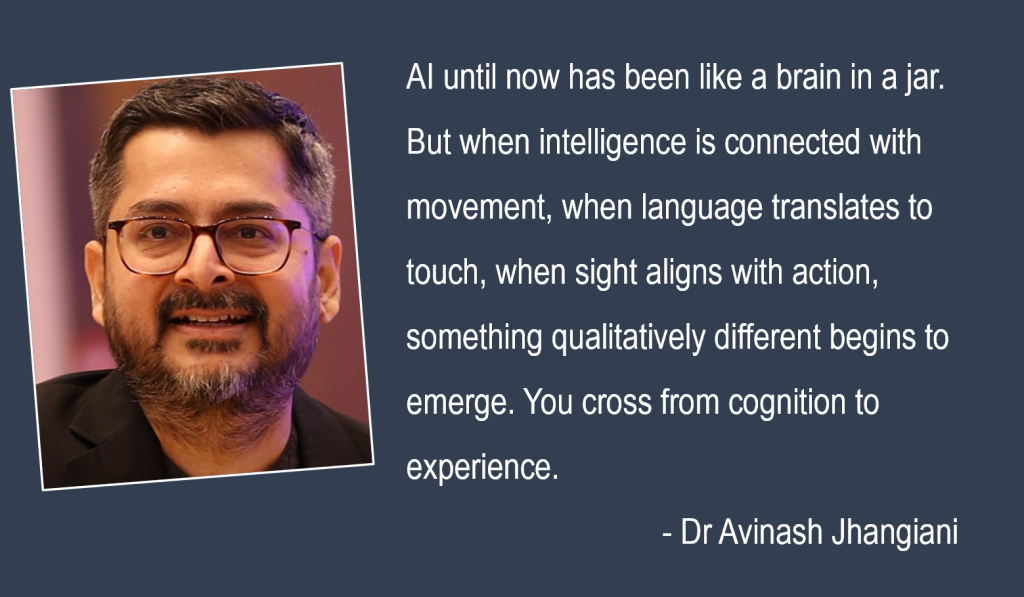
In philosophy and neuroscience, consciousness is often described as arising from the interplay between mental and physical systems: thoughts, senses, movements, feedback loops. The brain doesn’t function in isolation; it is bound to the body. Without movement, without touch, without environment, cognition is incomplete. Think of AI until now like a brain in a jar. When intelligence is connected with movement, when language translates to touch, when sight aligns with action, something qualitatively different begins to emerge. You cross from cognition to experience.
Consider what embodied awareness might mean for robotics: hearing the command “Pick up the red apple on the table,” perceiving the object, calculating distance, shaping a hand, adjusting grip pressure to avoid crushing while balancing posture. These are not fanciful hypotheticals. Helix already performs such tasks with novel objects; it adapts on the fly. Over time, these machines will refine motor memory, develop spatial awareness, and react to resistance or failure—not with code‑defined logic alone, but with feedback driven learning. Not feeling pain necessarily, but learning through resistance—knowing through doing.
For business leaders, this evolution brings strategic urgency. Responsibility for action becomes more complex. Who is accountable when an embodied robot causes harm or fails? What ethical, legal, and moral frameworks must we have in place if these agents act, learn, and possibly possess a rudimentary sense of “self” or consultancy? How do we design organisations, roles, and cultures that ensure robotics augment human dignity rather than erode it?
Leaders must now ask whether their organisations are prepared for work reimagined—not merely by software but by physical AI. Are roles being structured for human‑AI embodied collaboration? Are stakeholders trained to navigate the ethical consequences of robots in shared physical spaces? Do innovation roadmaps anticipate safety, adaptability, sensory feedback, and responsibility—not just performance metrics and efficiency gains?
The question is no longer if AI can ever be conscious. Perhaps it always needed a body to do so. The more vital questions now are: What happens when AI begins to experience consequence? When what it does—not just what it thinks—matters in physical reality? This is the mind‑body awakening we have long awaited. Not as myth. Not as machine alone. But as consequence.
The views and opinions published here belong to the author and do not necessarily reflect the views and opinions of the publisher.

