

Public Relations (PR) has long been recognised for building awareness, credibility, and trust. Through earned media coverage, thought leadership, and strategic storytelling, PR helps brands secure a position in the right conversations. However, in today’s fast-paced, ROI-driven marketing environment, many Chief Marketing Officers (CMOs) expect PR to deliver beyond its traditional remit — specifically, to generate business leads. This expectation has sparked an ongoing debate: Can PR truly deliver leads in the same way performance marketing does?
The Real Role of PR
At its core, PR excels in the upper and middle stages of the marketing funnel. Its strengths can be summarised as:
- Building Awareness – Making the brand visible to the right audiences through trusted third-party channels.
- Shaping Reputation – Establishing credibility and a distinctive brand narrative.
- Strengthening Brand Equity – Creating positive perceptions that influence long-term customer preference.
While these outcomes are essential to brand success, they do not directly equate to capturing emails, booking demos, or pushing prospects into a sales funnel. Pure PR does not inherently function as a direct-response channel.
Why CMOs Expect Leads from PR
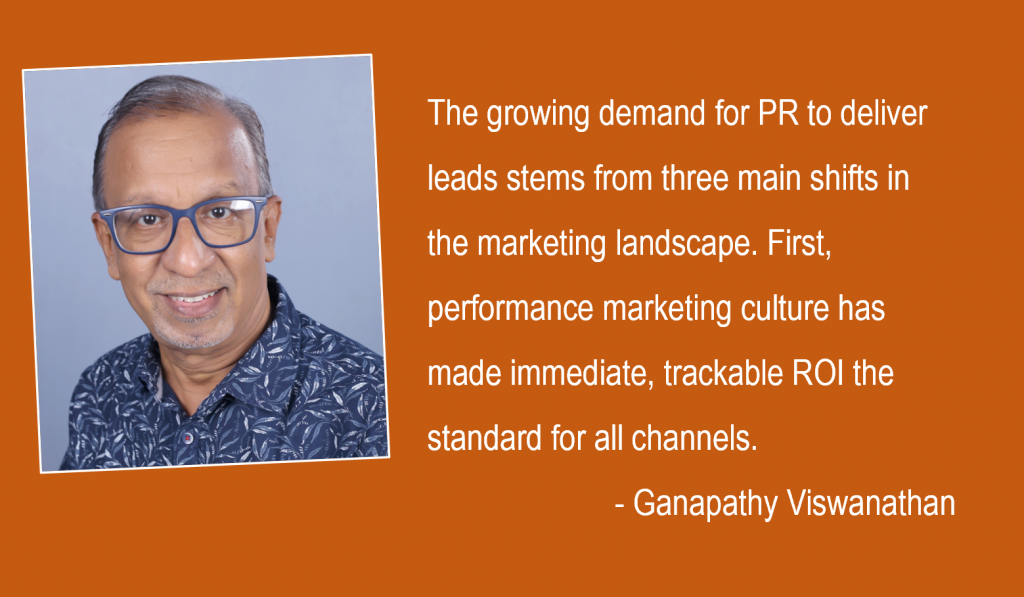
The growing demand for PR to deliver leads stems from three main shifts in the marketing landscape. First, performance marketing culture has made immediate, trackable ROI the standard for all channels. Second, discipline overlap — with content marketing, influencer marketing, and SEO — has blurred the lines between brand building and conversion. Third, budget accountability means every activity must show a tangible impact on revenue.
While these forces are understandable, they can lead to unrealistic expectations when PR is judged solely by lead-generation metrics.
How PR Can Influence Lead Generation
Even though PR is not built for direct lead capture, it can significantly influence and enable lead generation when integrated with the right strategies. For example:
- Driving Qualified Traffic – Earned media coverage often prompts readers to visit a company’s website or product page, especially if a clear call-to-action or link is included.
- Promoting Gated Content – PR can amplify reports, whitepapers, or webinars that require registration, creating a natural lead capture opportunity.
- Boosting SEO Performance – Coverage on high-authority websites improves search rankings, making it easier for prospects to discover the brand.
- Enhancing Conversion Rates – Third-party endorsements improve trust and increase the likelihood that prospects will respond to other lead-gen channels.
- Triggering Sales Conversations – Media coverage can give sales teams a timely “reason to reach out” and start meaningful discussions.
Measuring PR’s Contribution to Leads
To bridge the gap between awareness and measurable business outcomes, PR teams must use attribution and tracking methods that reflect their role in the customer journey. These can include:
- UTM-tagged links in online press mentions to measure referral traffic and conversions.
- Dedicated landing pages for PR-driven campaigns.
- Customer surveys asking “How did you hear about us?”
- Multi-touch attribution models that credit PR as an influence on leads.
- Time-lag analysis to link media coverage spikes to later increases in inquiries or sign-ups.
This type of tracking gives PR a tangible connection to pipeline influence without expecting it to behave like a pure performance channel.
Where Influencer Marketing Fits
Influencer marketing often falls under PR, but its objectives can be different. When the goal is awareness and credibility, it behaves like traditional PR. When the goal is clicks and conversions, it should be structured more like a performance campaign, with tracking links and clear calls to action. Confusing these goals can cause misalignment in expectations and results.
Setting Realistic Expectations
PR works best when positioned as a top- and mid-funnel powerhouse that can feed demand into the pipeline when paired with other tactics. The most effective approach is integration: pairing PR coverage with gated resources, optimising SEO to capture search demand it creates, enabling the sales team with media mentions, and retargeting audiences who arrive through earned media.
When these elements work together, PR becomes a demand-generation accelerator rather than just a reputational tool.
The Bottom Line
PR alone won’t fill a CRM with qualified leads, but dismissing its role in business growth is a mistake. It creates the trust, awareness, and preference that make lead-generation campaigns more effective and sales outreach more successful. The best CMOs recognise that PR sets the stage, performance marketing drives the action, and sales closes the deal.
When PR is integrated into a well-structured marketing ecosystem, its contribution to leads is not only possible but also measurable — and that’s the true formula for sustainable growth.
The views and opinions published here belong to the author and do not necessarily reflect the views and opinions of the publisher.

