

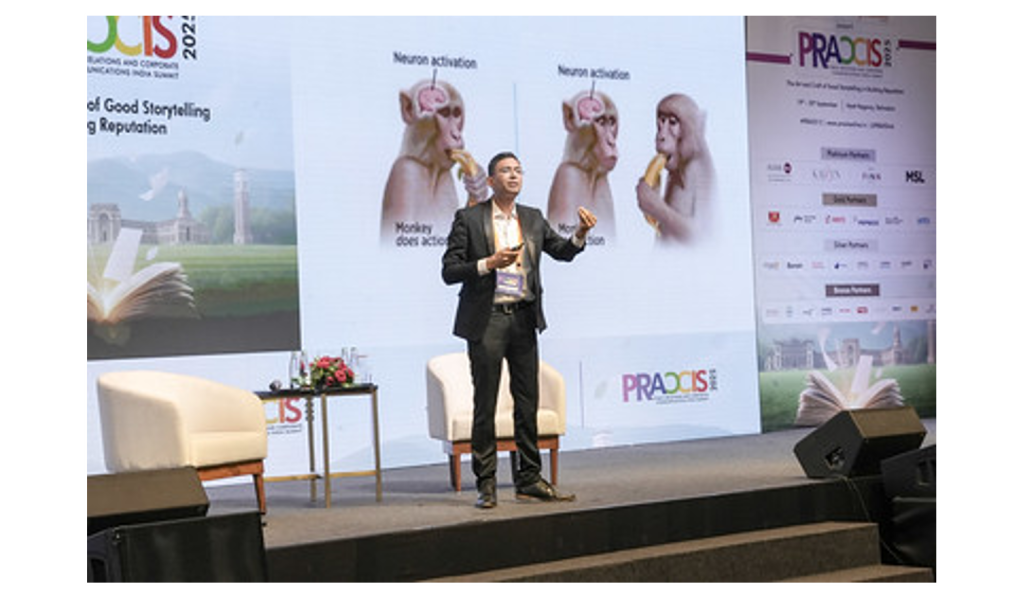
Raja Jamalamadaka revealed at PRAXIS12, how our brains unlock empathy & connection, when narratives are told with purpose and simplicity.
The spotlight turned to science – neuroscience, to be precise, at #PRAXIS12 as Raja Jamalamadaka, a neuroscience expert, delivered a fascinating keynote on “The Role of our ‘Brain’ in Unlocking the Power of Stories.” His talk made one thing clear: stories aren’t just entertainment; they are hardwired into the very way our brains process information, connect with people, and build meaning.
So, what really happens inside the brain when a story is told? Raja illustrated that at the center of it all is what he described as the ‘heart of the brain’ – the part that is responsible for empathy and emotional connection. This is where stories work their ‘magic’. “This part of the brain doesn’t let in information easily,” he said. “But stories are the bridge. The better the story, the more seamless the communication.” In other words, if you want to reach someone’s heart, skip the jargon and lead with narrative.
To illustrate this, Raja drew from some of the world’s most effective storytelling frameworks. He reminded the audience that even Steve Jobs, often called the world’s best storyteller, leaned heavily on narrative structure to inspire action. He then broke down a few well-known frameworks:
- The Pixar Story Frame: Set the scene, show the routine, introduce change, reveal consequences, and finally, offer the solution. Ideal for presenting new ideas in ways that captivate and win buy-in.
- Simon Sinek’s Golden Circle: Start with why, then how, and finally what. A purpose-driven framework that rallies teams and roots brands in deeper meaning.
- The StoryBrand Framework: Make your customer the hero, not the brand. Perfect for marketing copy, sales decks, and simplifying complex messaging.
- The Hero’s Journey: Position leadership or a brand within a transformational arc. This is best for personal brand building, founder narratives, or motivational talks.
“Express, don’t impress,” Raja advised, distilling the essence of what makes stories truly connect. Beyond frameworks, he pointed to the importance of authenticity and simplicity.
He also brought data into the equation: 93% of communication is non-verbal. This is why visuals, especially videos – are so effective at holding attention in today’s fast-moving, screen-first world. And, what is the takeaway? To engage modern audiences, stories need to be seen and felt, not just read or heard.
Raja wrapped his keynote with some refreshingly simple rules of thumb. When he quoted the KISS mantra – “Keep It Simple, Stupid” – drew nods from the audience. “Let people buy, don’t sell,” he insisted. The role of storytelling is not to convince through force or overwhelm people with over-communication. Instead, it’s about letting the story speak for itself, leaving space for audiences to connect, interpret & take action on their own terms.
His final note was both practical and inspiring: don’t lean on stereotypes, use data to shape stories, and always aim to express with honesty. After all, when told right, stories are not just messages – they are experiences that our brains are wired to embrace.
In a conversation with Jasrita Dhir, Ashoka University who commented that neuro marketing has taken leaps ahead, but the communication industry lags behind. How can communicators use neuro science? Don’t be afraid of technology was his take and he went on to say – adopt AI tools well and also identify your ‘authentic’ self.
We may all ask ourselves – what is your wellness score? Normalising mental wellness still goes a long way. It is OK not to be OK if you ask for help in the right way, she said. And, one can step out too, and involve in activities like cultivating your 3AM friend.
Today we go to ChatGPT etc and use AI tools galore. Do we stop thinking? What is the future ahead? Good thoughts to help us move forward.
The views and opinions published here belong to the author and do not necessarily reflect the views and opinions of the publisher.