

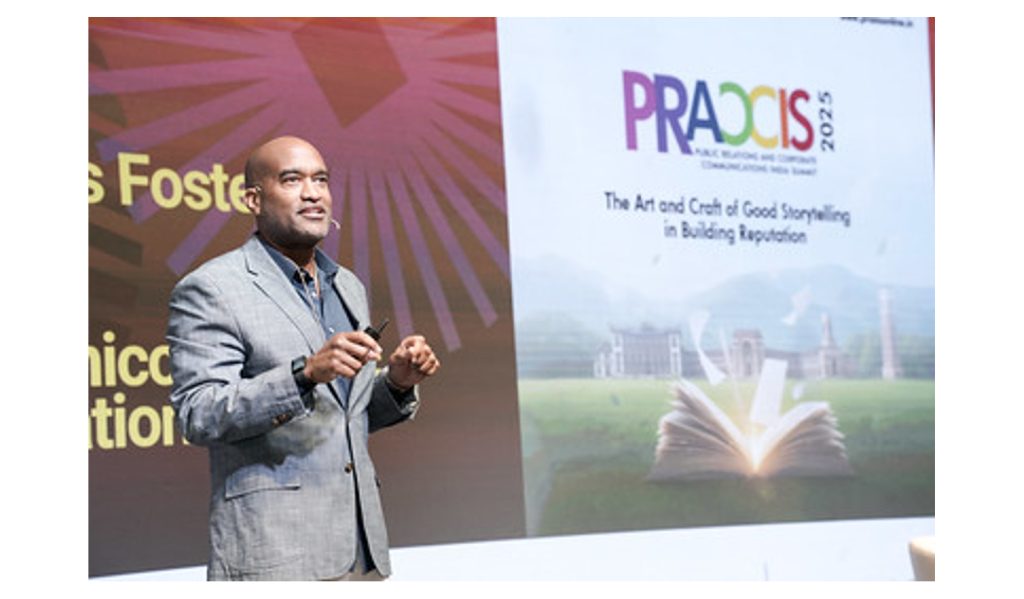
Chris Foster declared creativity as the ultimate differentiator at #PRAXIS12 – urging PR professionals to embrace storytelling as strategy itself
Taking the stage at #PRAXIS12 Chris Foster, CEO of Omnicom Public Relations Group asserted – “Creativity is the ultimate differentiator”. His keynote, “The Story is the Strategy: The Relevance of Stories in the Age of AI,” was both a call to arms and a reminder, that in today’s fast-evolving communications landscape, stories are no longer just part of strategy – they are the strategy.
Foster began with a simple, but powerful truth: the starting point is creativity. Storytelling is not merely evolving but being disrupted, he pitched. The change is not just in how stories are told, but in who gets to tell them. He illustrated this shift with the Lucky Yatra campaign by Indian Railways, a Cannes Lions winner. Unlike campaigns that invent problems to solve, this one tapped into an authentic opportunity and moved people emotionally. “That’s the power of storytelling,” Foster exclaimed. Yet, he also pointed out a sobering fact – that in 2025, far more Gold Lions were awarded to ad consultancies than to PR consultancies. This was a clear signal that PR must step up and seize its storytelling power!
He challenged the audience with a provocative question: “Did your last story drive culture, or just coverage?” Stories, he said, have always shaped commerce, culture & connection. While coverage may fade, true connection endures. Technology may alter the channels and formats of stories, but the ‘why’ of storytelling – to move people, to connect meaningfully – remains constant.
Tracing the arc of storytelling from the newspapers of the 1600s to today’s omnichannel ecosystem, Foster highlighted how the lines between advertising, marketing, and PR are blurring. Instead of viewing this as a threat, he called it an opportunity. The integrated ecosystem demands that PR claim its seat at the strategy table.
A highlight of his talk was his nuanced perspective on AI. “AI can tell a story, but AI isn’t a storyteller,” he clarified. To him, AI is like a piano: it can play every note flawlessly, but it is the human pianist who evokes emotion and makes the performance unforgettable. Technology can aid storytelling, but human creativity is what transforms communication into culture.
Foster underscored that stories don’t just explain strategy – they are strategy in motion. They solve business problems, survive news cycles, and safeguard reputation. He cited enduring examples like Jordan and Apple – brands whose stories became their greatest assets. “If you are in PR,” he said with conviction, “you’re not behind the scenes, you’re behind the strategy. That gives us a different level of power.”
In a crescendo of passion, Foster declared:
- “We’re more than communicators – we’re architects of meaning”.
- “We don’t just shape perception – we shape outcomes”.
- “Our stories don’t just inform – they move people.”
Closing his talk, he emphasised: “When your stories have clarity, creativity, and consequence, you are more powerful than you realise.”
In the Age of AI, Foster left no doubt: the most powerful ideas in culture will continue to originate from PR strategy rooms. And at the heart of it all lies one enduring truth – the story is the strategy.
In a conversation with Arun Sudhaman, The Promise Foundation who questioned – If the most cultural ideas start in the PR rooms, how important is it protecting it in places like Cannes? People under-represent it, was the picture Foster shared.
From a competitive spirit, what are the unique advantages of PR? What was his take? “All relationships are earned; I think the story is much more important than we realise. The story should be the strategy – this is what we should adapt”.
And how is AI changing the way firms work? According to his point-of-view, he would use AI as a partner, and elaborated that “it should take some functions out of the frame, but it’s fine!”
How ready is the industry for that change? We’ve got to catch up, he said.
With a firm opinion that India is now in the growth market, his clear direction on the path ahead was – “the objective is to find ways to drive growth”.
The views and opinions published here belong to the author and do not necessarily reflect the views and opinions of the publisher.