

7. Virality as a Reputation Multiplier: When One Clip Becomes a Crisis
The defining change in India’s reputation environment is not the emergence of a new category of risk, but the sheer speed with which an issue can travel. A comment, video or unverified claim from an otherwise insignificant setting can reach a national audience within hours. Online communities can investigate, challenge or validate it before the organisation or individual involved has had time to establish the facts or decide how to respond. That loss of response time is itself a reputational risk. It applies to companies and institutions, but increasingly to individuals as well: a single moment captured on camera can affect a person’s professional standing just as quickly as it can attach itself to a corporate brand.
The 2026 Galgotias University episode offers a useful illustration of how this dynamic works. At an international event in New Delhi, a faculty representative of the University showcased a robotic dog as part of the university’s Centre of Excellence presentation. After her remarks were aired on a state broadcaster, online users began challenging the claim and the story escalated quickly. Summit organisers asked the university to vacate its stall, international media picked up the episode within a day, and the matter was raised in the Uttar Pradesh Legislative Assembly within the week. The statements that followed the initial episode compounded the damage, keeping the issue in the public conversation for longer.
The sequence is now familiar across viral reputation crises. An incident emerges from an informal setting; online audiences investigate it at speed; mainstream media or political actors broaden its reach; and the organisation or individual then has to respond under intense scrutiny. At that point, the response can matter as much as the original incident. Attempts to deflect responsibility or cover up an issue can turn a manageable episode into a larger question about institutional accountability.
This changes what reputation preparedness needs to cover. Organisations require social listening and verification systems that can operate at internet speed, along with clear protocols for situations involving people who may not be official spokespeople but are nevertheless associated with the brand. The same principle applies to individual leaders and employees. Public and professional identities are increasingly connected, making personal conduct a reputational consideration not just for the individual but for the organisation with which that person is associated.
Reputation strategy has to extend beyond spokesperson training and official messaging to include real-time social listening, verification protocols that move as fast as the internet does, and clear guidance on how leadership responds when the person at the centre of a viral moment is not a company spokesperson but simply someone associated with the brand.
8. What This Means for Corporate India
Taken together, these shifts point toward a small number of practical priorities for boards, CEOs, and communications leaders operating in India today:
Reputation should be embedded within governance rather than treated solely as a communications responsibility. Consider reputation implications alongside legal, financial and operational risks, ensuring communications leaders are integrated into strategic decision-making rather than engaged only during periods of crisis. Build crisis protocols assuming a compressed timeline between internal discovery and public exposure, not a multi-week buffer.
Transparency has become an enduring source of competitive advantage. As disclosure requirements become more comprehensive and publicly accessible, organisations should Invest in BRSR and ESG disclosure quality, not just compliance. Treat the disclosure itself as a reputational document that will be read by stakeholders far beyond the regulator.
Leadership visibility requires institutional discipline. Executive communication has become an extension of corporate reputation. Organisations should develop integrated frameworks that align leadership narratives with corporate purpose, establish consistent engagement practices and prepare executives for increasingly complex public scrutiny.
Regional reputation deserves greater strategic attention. India’s communications landscape is no longer concentrated exclusively within metropolitan centres. Build regional and Tier-2 reputational strategy deliberately, rather than defaulting to metro-centric narratives and media plans.
Artificial intelligence demands both adoption and governance. Prepare for AI-mediated reputation. Monitor and manage how AI systems represent the brand, and build internal capability to detect and respond to AI-driven misinformation quickly.
Credibility should take precedence over visibility. The growing convergence of earned, owned and paid communication has made authenticity a more valuable differentiator than volume alone. Organisations that consistently demonstrate transparency, independent validation and responsible disclosure are likely to sustain stronger stakeholder confidence over the long term.
Preparedness must reflect the realities of a real-time information environment. The distinction between operational readiness and reputational readiness is becoming increasingly narrow. Organisations capable of responding quickly, accurately and transparently are better positioned to retain stakeholder trust when unexpected issues arise.
Conclusion
Corporate reputation in India is being reshaped by forces that extend well beyond traditional communication.
High institutional trust continues to provide organisations with an important foundation, yet that trust is becoming progressively more conditional. Governance quality, leadership credibility, disclosure standards, digital behaviour and technological change now interact continuously to influence how organisations are perceived.
These shifts do not suggest that reputation has become more fragile simply because information travels faster. Rather, they indicate that stakeholders now possess greater visibility into organisational behaviour and correspondingly higher expectations of institutional accountability. Reputation is therefore evolving from an outcome of communication into an indicator of organisational quality.
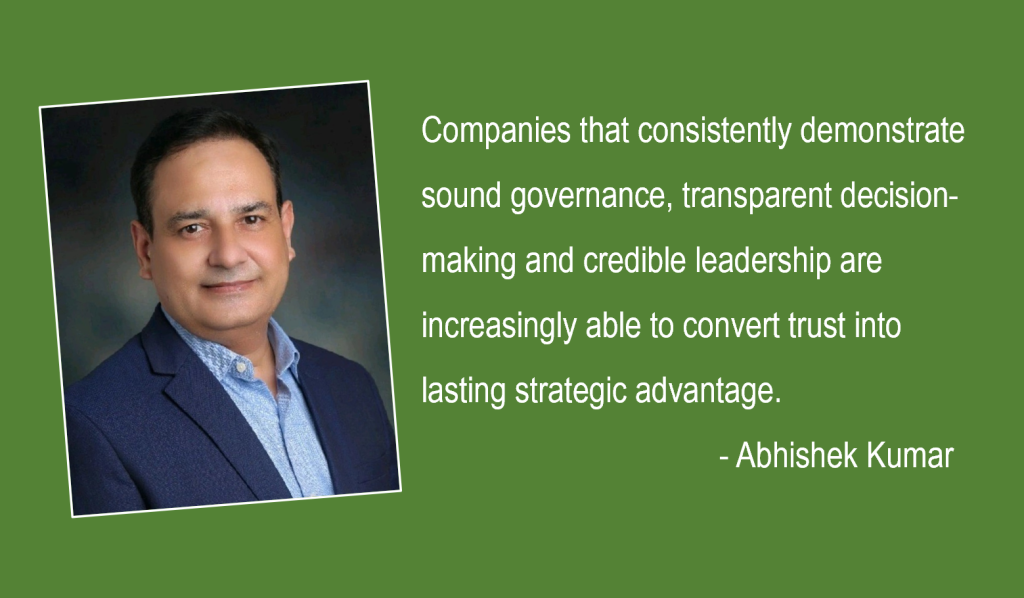
Companies that consistently demonstrate sound governance, transparent decision-making and credible leadership are increasingly able to convert trust into lasting strategic advantage. Those that depend primarily on brand visibility or historical goodwill may discover that reputation accumulated over decades can erode rapidly when organisational conduct fails to meet contemporary expectations.
The challenge for corporate India is not merely to communicate more effectively, but to ensure that governance, culture, leadership and communication reinforce one another.
The organisations that will protect and compound their reputational capital over the next few years will be the ones that stop treating reputation as a communications output and start treating it as a governance discipline. In an environment where every disclosure, executive action and digital interaction contributes to public perception, credibility will increasingly depend on how consistently institutions align what they say with what they do.
_______________________________________________________________________________________________________________________________
The views and opinions published here belong to the author and do not necessarily reflect the views and opinions of the publisher.