

5. The CEO Is the Brand: Executive Reputation as Enterprise Value
Perhaps the most significant shift for practitioners is the extent to which corporate reputation has become inseparable from individual leadership reputation. Once largely represented through formal interviews, annual reports and investor interactions, CEOs and founders now engage directly with customers, employees, policymakers and the wider public through digital platforms. This shift has fundamentally altered the relationship between individual and institutional reputation. Leadership today is communicated as much as it is exercised.
India’s traditionally reserved corporate culture is visibly changing on this front. CEOs and founders are more publicly vocal than at any point in the past, using LinkedIn and other platforms to build authority and shape narrative directly – bypassing traditional media gatekeeping entirely. But the same visibility that builds a reputational premium can just as quickly become a liability: public, personal exchanges between executives and critics have already shown how a leader’s individual conduct online can rapidly become entangled with brand perception, for better or worse.
This shift is vivid across corporate India, where a leader’s unscripted voice can either erode market value or anchor enterprise resilience. On one extreme, Ola Founder’s combative online spat with a critic showed a huge dent on its market cap in a single trading session, while Infosys and L&T leadership remarks on ‘Work Life’ generated prolonged PR friction for their employer branding. Conversely, Vijay Shekhar Sharma’s rapid public assurances during Paytm’s regulatory crisis helped stem merchant churn, and Radhika Gupta’s relatable “Dal-Chawal” investing philosophy built deep, organic retail investor trust for Edelweiss AMC without heavy advertising spend. Further underscoring this volatility, Lenskart founder Peyush Bansal recently had to step in personally with a public apology after an internal grooming policy went viral and triggered boycott calls, demonstrating how quickly a CEO’s direct communication becomes the frontline for protecting corporate equity.
Research increasingly attributes a substantial share of a company’s overall reputation to perceptions of its chief executive, with executive credibility influencing investor confidence, stakeholder trust and organisational resilience during periods of uncertainty. Studies referenced in the source also indicate that CEO reputation contributes meaningfully to enterprise value, reflecting the premium markets place on trusted leadership.
Two disciplines follow from this. First, executive communications can no longer be treated as separate from corporate communications – they need a shared narrative, a shared risk register, and shared crisis protocols. Second, authenticity is being tested harder than before: audiences are increasingly able to detect scripted or AI-generated thought leadership, and detecting it damages credibility rather than building it. The Indian market’s growing embrace of CEO visibility raises the bar for quality and judgement, not just volume of posting.
6. AI: Reputation’s Newest Amplifier — and Threat
Artificial intelligence cuts both ways in the Indian reputation landscape. On one side, communications teams are adopting AI rapidly for research, content creation, and monitoring – PRCAI’s data shows AI’s share of industry revenue more than tripling in three years, with further growth expected. On the other, AI-generated misinformation and deepfakes are now identified as a top reputational risk by the large majority of India’s senior communications professionals, and most expect formal AI governance frameworks to become mandatory in the near term.
| PRCAI SPRINT 2026 — India Communications Industry Snapshot | |
| AI share of industry revenue (3 yrs ago → 2026) | 2% → 7% |
| Respondents flagging AI misinformation as major risk | 80% |
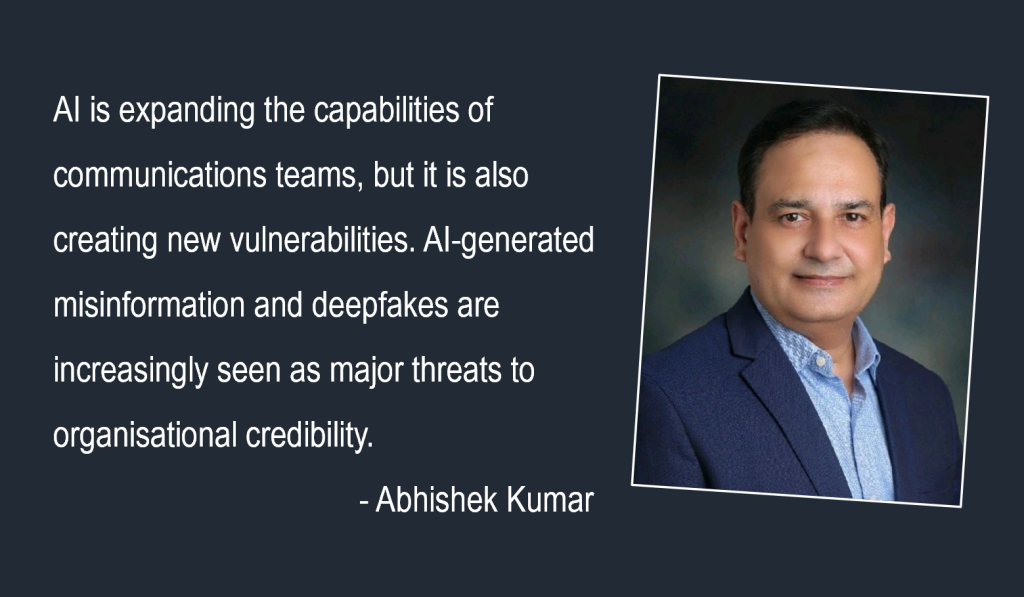
AI is expanding the capabilities of communications teams, but it is also creating new vulnerabilities. AI-generated misinformation and deepfakes are increasingly seen as major threats to organisational credibility. These synthetic contents are becoming easier to create, harder to distinguish from reality and faster to circulate. The risk is therefore not simply how an organisation responds once false information is exposed, but whether it is prepared to verify and counter fabricated content before it gains wider acceptance. Effective response will depend on strong verification protocols; clear governance and the institutional trust built with stakeholders over time.
AI is also changing how reputation itself is formed. Large language models increasingly draw on independent news coverage, expert commentary and other credible third-party sources when describing companies and their leaders. A company’s reputation is consequently being shaped not only by what it publishes, but by how it is represented across the wider information ecosystem and, increasingly, within AI-generated answers. This makes earned credibility more valuable, while placing new demands on organisations to govern their use of AI, maintain reliable information and monitor how they are represented. AI is therefore not simply another communications tool; it is changing the information environment in which corporate reputation is built and judged.
Reputation strategy is starting to require a genuinely new competency: managing how an organisation is represented inside AI-generated answers, not only in traditional search and media.
__________________________________________________________________________________________________________________________________
The views and opinions published here belong to the author and do not necessarily reflect the views and opinions of the publisher.